
In any enterprise Microsoft Dynamics 365 Commerce implementation, one of the most critical decisions a functional consultant faces is defining the boundary between out-of-the-box (OOTB) configuration and custom code development.
Retail environments are fast-paced, highly visible, and deeply tied to customer experience. When business stakeholders or store managers review a new D365 Commerce system during early playback sessions, their natural instinct is to point out every minor difference between the new platform and their legacy Point of Sale (POS) or e-commerce solution.
The immediate reaction from non-technical project leaders is often:
“Let’s write a quick customization so the store cashiers don’t have to change their daily habits.”
However, jumping straight to custom development is a costly trap. Over-customizing D365 Commerce inflates implementation budgets, delays go-live schedules, increases total cost of ownership (TCO), and introduces severe complexities during continuous service updates from Microsoft.
As functional consultants, solution architects, and delivery leads, our job isn’t just to build whatever is requested—it is to safeguard the long-term health of the client’s ERP ecosystem.
Before recommending custom code, evaluate these 7 critical lenses to determine whether a requirement actually justifies customization—or if saying “no” is the best value you can provide.
1. Can Standard Configuration Meet the Requirement?
Dynamics 365 Commerce is an exceptionally rich platform. Before declaring a feature missing, thoroughly audit the native setup options available in both the Back Office (HQ) and the Commerce Scale Unit (CSU).
Many complex business requirements can be satisfied without writing a single line of code simply by combining built-in features:
- Pricing & Promotions: Instead of writing custom discount logic, explore advanced price groups, mix-and-match thresholds, quantity discounts, and customer-specific price attributes.
- Merchandising & Assortments: Utilize retail channel navigation hierarchies, category attributes, and dynamic assortments to control product visibility across physical stores and e-commerce channels.
- POS Screen Layouts & Operations: Before requesting custom POS buttons, leverage the built-in Screen Layout Designer, Button Grids, and standard POS Operations.
- Workflows & Approval Limits: Use native business process workflows in D365 Headquarters to control overrides, inventory adjustments, and back-office approvals.
Consultant Action: Always prototype the requirement in a sandbox environment using standard parameters first. Show the client how the native setup works before agreeing to a design change.
2. Is the Requirement Really a Business Need—or Just Legacy Habit?
A common mistake in enterprise implementations is confusing business requirements with legacy operational habits.
When a client requests a specific pop-up screen or custom workflow in Store Commerce, ask probing questions:
- “What core business problem does this process solve?”
- “Is this required for regulatory compliance, audit ability, or revenue generation?”
- “Or was this step only necessary because your previous 10-year-old POS system had functional limitations?”
Replicating old system flaws inside a modern platform like D365 Commerce negates the very reason the business invested in a digital transformation. Part of a functional consultant’s role is guiding change management and encouraging clients to adapt their business processes to proven, industry-standard ERP practices.
3. What is the Impact on Standard Architecture & Transaction Flow?
D365 Commerce relies on a modern, decoupled architecture powered by the Commerce Scale Unit (CSU), Store Commerce App, and Headless Commerce APIs. Customizing this ecosystem isn’t as simple as adding a custom field to a traditional back-office form.
Customizing core commerce operations can have cascading effects across your tech stack:
- Offline Capabilities: Does your custom POS logic break when a store loses internet connectivity and operates in Offline Mode?
- Transaction Latency: Will heavy custom calculations added to the Commerce Runtime (CRT) slow down checkout times at the register during peak holiday sales?
- Data Synchronization: Does your custom data require complex synchronization via Real-time Service or Commerce Data Exchange (CDX) jobs, creating potential syncing bottlenecks?
A customization should never jeopardize system stability, transaction speed, or the core store checkout experience.
4. What is the Long-Term Maintenance & TCO Impact?
Writing custom code is a one-time expense; maintaining custom code is an ongoing financial obligation.
Every custom POS extension, custom CRT API, or modified back-office data model requires continuous support across the entire software life cycle:
- Developer Overhead: Who maintains the code-base when the original implementation team rolls off?
- Documentation & On boarding: Are you creating unique technical debt that will require specialized training for future IT hires?
- Testing Expenses: Custom logic must be manually re-tested across every channel (Store Commerce for Windows, iOS, Android, and Web) whenever changes are made.
If a custom feature costs $10,000 to build but adds $30,000 in recurring testing and maintenance costs over three years, its long-term return on investment (ROI) is negative.
5. Is There a Practical Standard Workaround?
Functional consultants should always act as problem-solvers before becoming technical spec writers. When standard configuration falls slightly short of a client’s dream scenario, explore alternative business workarounds.
For instance, if a retailer wants a specialized multi-step approval process for high-value customer returns that D365 POS doesn’t natively support out-of-the-box:
- Option A (Customization): Build a custom POS view, extend the CRT, create custom database extension tables, and modify the hardware station.
- Option B (Standard Workaround): Configure standard POS Manager Overrides at the register for immediate approvals, paired with standard HQ audit reports for post-transaction review.
Option B delivers 90% of the risk mitigation with 0% custom development risk. Presenting these trade-offs clearly allows business sponsors to make informed financial decisions.
6. What Happens During Future One Version Upgrades?
Microsoft operates on a One Version continuous update model for Dynamics 365, releasing regular service updates to ensure security, performance, and feature parity.
While Microsoft’s sealed installer framework and modern Commerce SDK isolate customization’s from core application binaries, heavy extensions still carry upgrade risks:
- Custom CRT triggers might conflict with newly released Microsoft feature flags.
- Deprecated APIs or UI controls can require emergency code refactoring.
- Extensive custom code expands the scope of required regression testing during major service update cycles.
Keeping your D365 Commerce environment close to standard guarantees smoother, low-friction platform updates with minimal testing downtime.
7. Is the Customization Worth the Actual Business Value?
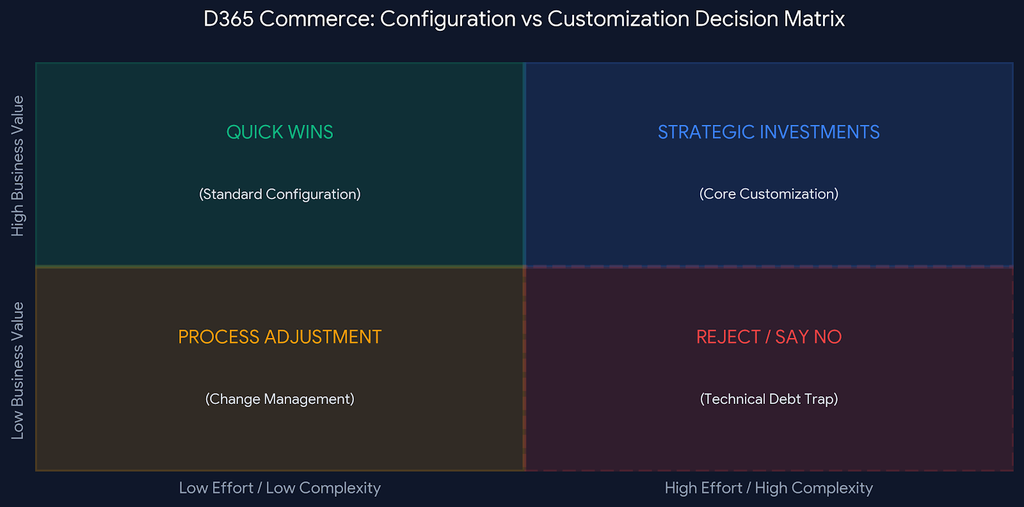
Not every functional gap is created equal. To prioritize effectively, map every proposed customization against a simple Value vs. Effort Matrix:
 ┌─────────────────────────────┬─────────────────────────────┐
 │      HIGH VALUE / LOW EFFORT│    HIGH VALUE / HIGH EFFORT │
 │  👉 Quick Wins              │ 👉 Strategic Investments   │
 │  (Proceed with Config /     │    (Carefully Architected  │
 │   Light Extensions)         │     Customizations)        │
 ├─────────────────────────────┼─────────────────────────────┤
 │       LOW VALUE / LOW EFFORT│       LOW VALUE / HIGH EFFORT│
 │  👉 Process Adjustment      │  👉 REJECT / SAY NO         │
 │     (Change Management)     │     (Unnecessary Technical  │
 │                             │      Debt)                  │
 └─────────────────────────────┴─────────────────────────────┘
If a proposed customization falls into the Low Value / High Effort quadrant—meaning it requires complex CRT/POS development just to save a store clerk two mouse clicks—it should be firmly challenged and rejected. Reserve your development budget strictly for features that drive competitive advantage, revenue growth, or regulatory compliance.
Summary: The Role of a Strategic Consultant
A functional consultant’s value isn’t measured by how many custom functional design documents (FDDs) they write. It is measured by how successfully they deliver a stable, scalable, and maintainable platform that solves real business problems.
When evaluating a new requirement in D365 Commerce, don’t just ask:
“Can we customize this?”
The far more powerful question is:
“Should we customize this, or can we solve it better through standard capabilities and process optimization?”
Mastering the art of saying “no” to unnecessary customization’s keeps your implementation leaner, lowers ongoing costs, and builds a sustainable foundation for future retail growth.
About The Author